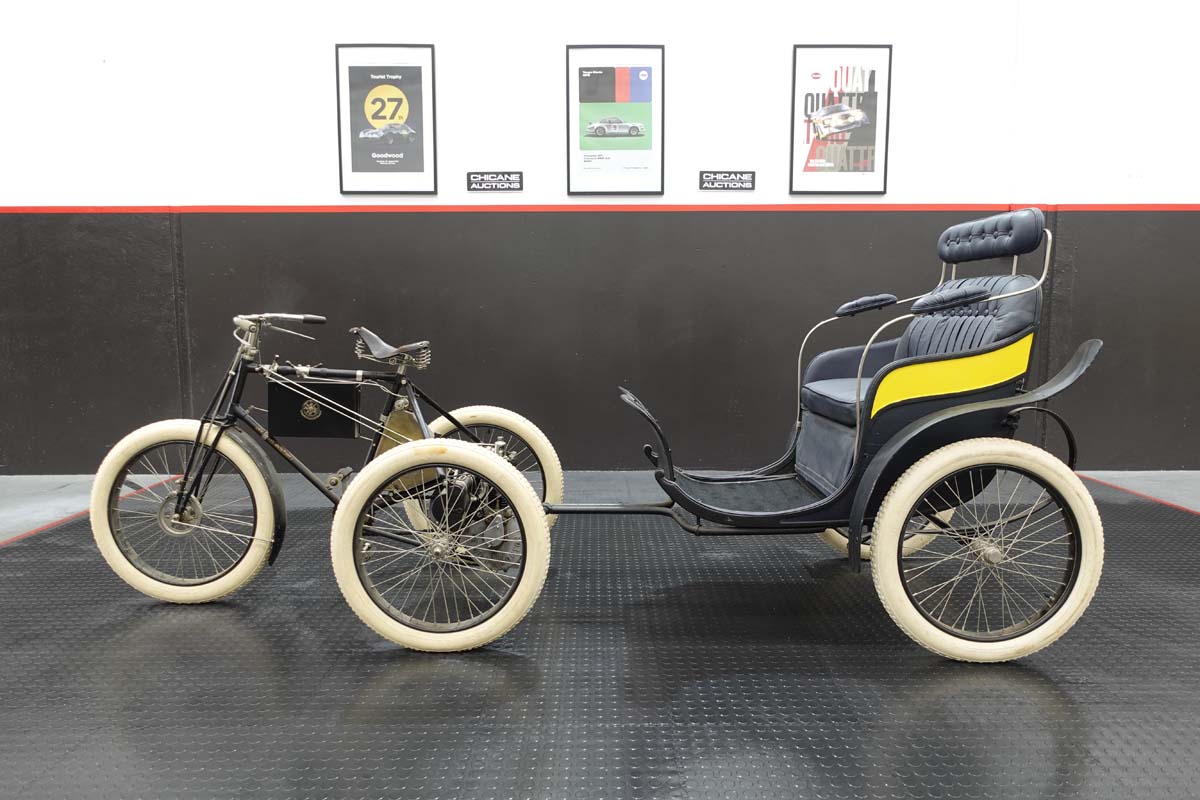
A remarkable vehicle, this trike from the dawn of the automotive age has a remarkable history, too.
Words: Mike Ryan
Photos: Courtesy of Chicane Auctions
De Dion-Bouton is a name few people know of today. Car guys may be able to tell you about the De Dion back end in their classic sports car, but ask for more on the company that designed that suspension and you’ll usually draw a blank. Go back 125 years and it was a different story…
At the dawn of the 20th Century, De Dion-Bouton was the equivalent of Ford or Toyota today – one of the largest automobile manufacturers in the world. Germany may have invented the internal combustion automobile, but it was French companies like De Dion-Bouton that popularised it before America industrialised it.
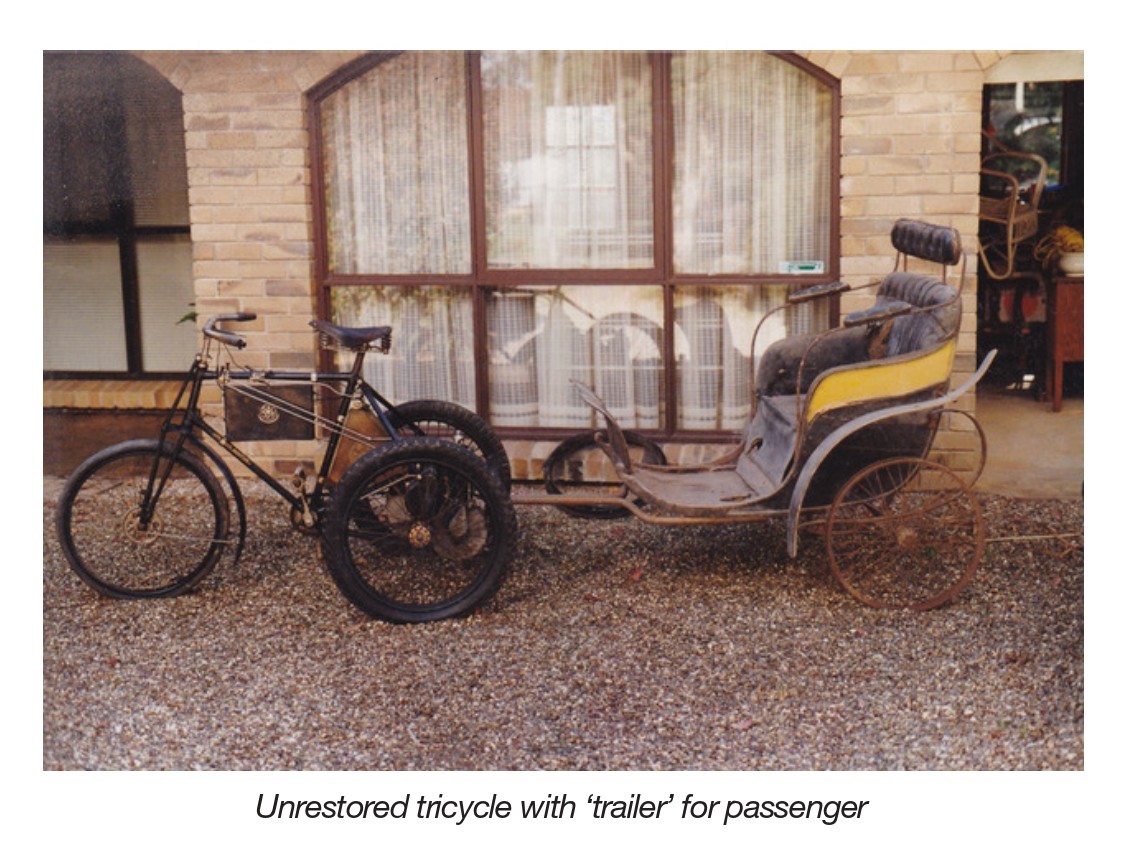
The tricycle and sulky prior to restoration.
The Count and the Toymakers
Despite the double-barrelled name, De Dion-Bouton was the creation of three people - at least initially. Jules Félix Phillipe Albert de Dion de Wandonne (Albert de Dion for short) was a French nobleman whose family fortune enabled him to indulge various passions, one of which was steam-powered machinery. That drew him to Georges Bouton and Charles Trépardoux, who were building scaled-down steam vehicles as toys. Trépardoux had ambitions of building a 1:1 scale steam vehicle, so with de Dion’s backing, they formed Trépardoux et Cie in 1883.
Steam-powered generators and locomotives were the first products, with a roadgoing vehicle introduced in 1884. That was a four-wheeler, with a three-wheeler added in 1887, but the complexity and maintenance required for steam-powered vehicles meant the take-up was low.
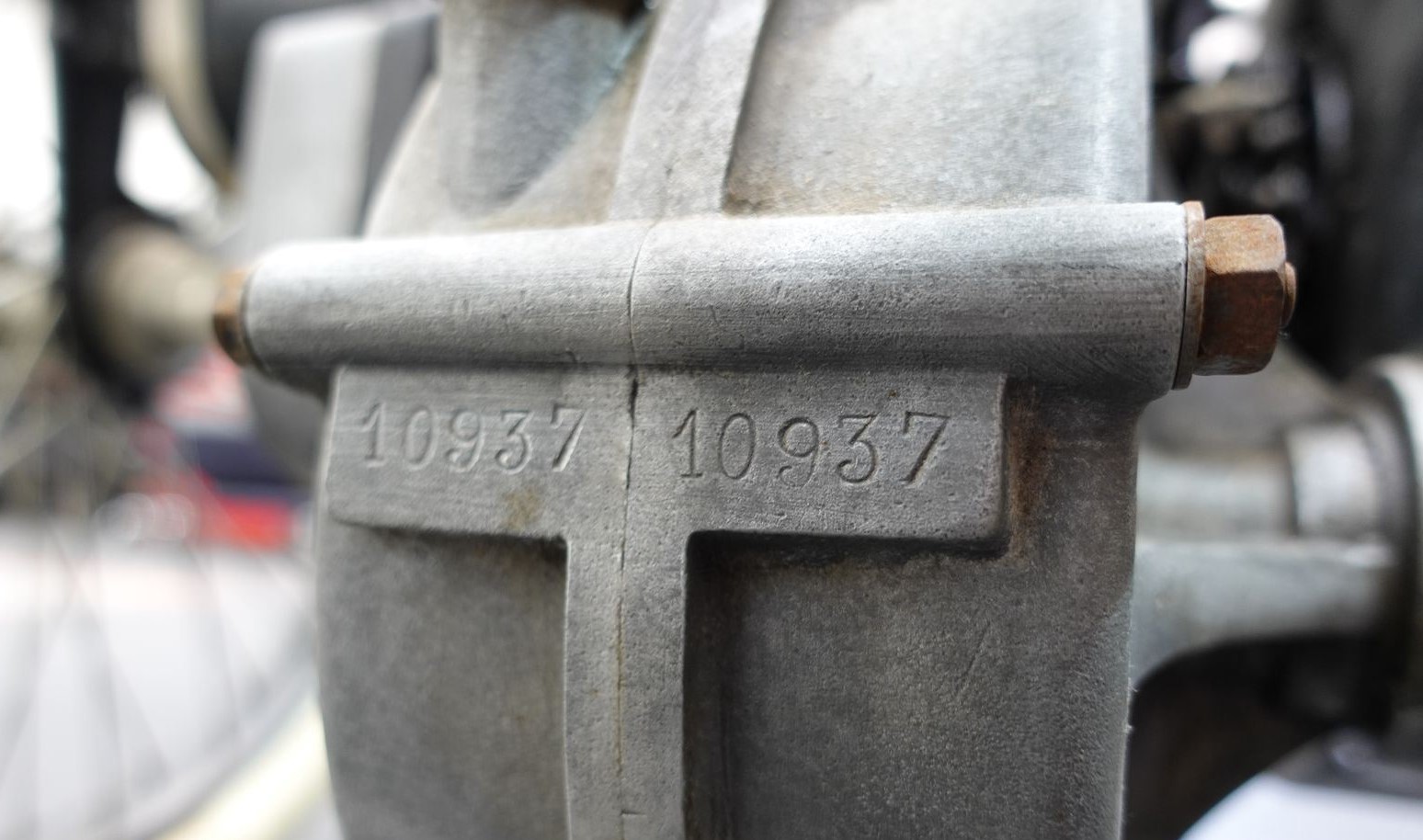
The same serial numbers on each side of the crankcase identify this as a matching numbers engine.
Moving to Internal Combustion
By 1889, de Dion was exploring “explosion motors” (ie. internal combustion engines) of the type that Daimler and Benz had introduced. Bouton was experimenting with internal combustion at this time, too.
Whether it was prescience or indulgence, de Dion saw more potential in internal combustion than steam. That led to a rift with Trépardoux, who left the company in 1893, leading to its rebrand as De Dion-Bouton.
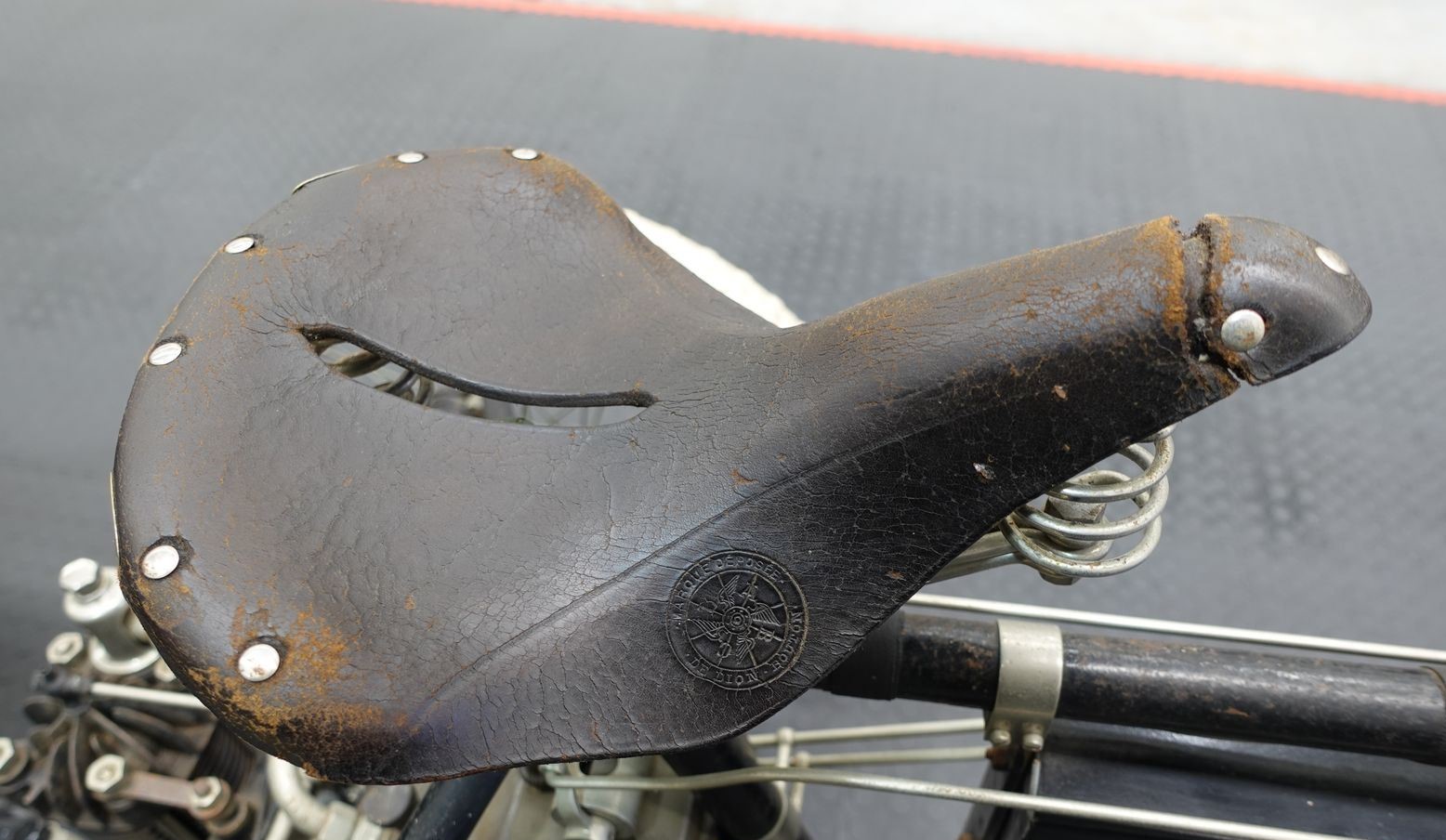
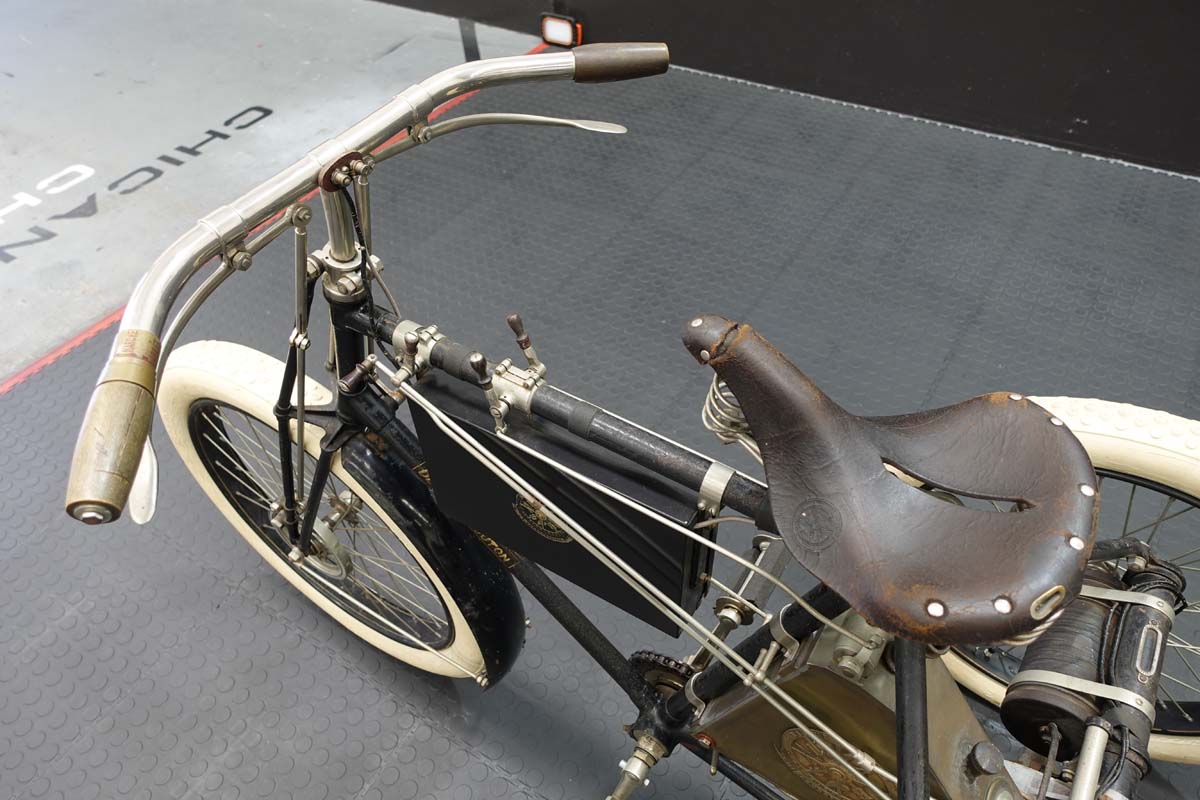
Leather saddle is original, bearing the De Dion-Bouton trademark.
Trikes to the Fore
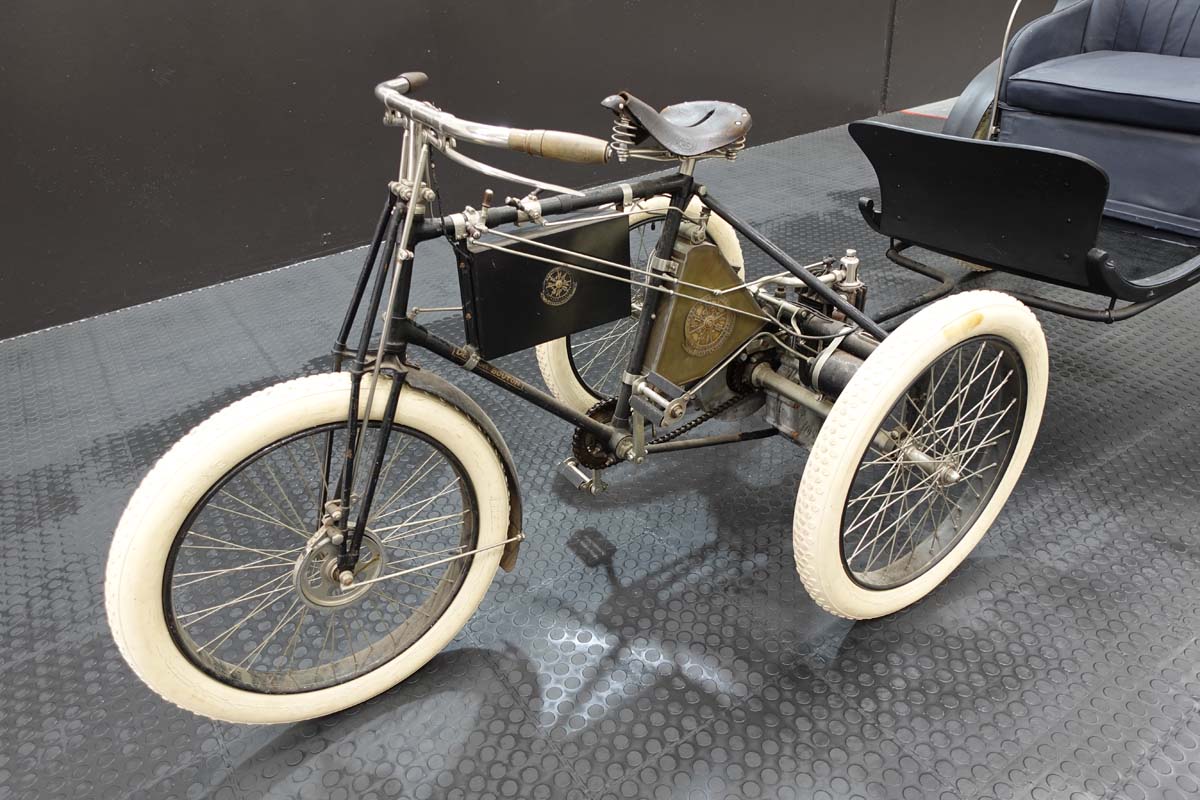
With their focus now firmly on internal combustion, De Dion-Bouton produced their first internal combustion ‘motor tricycle’ in December, 1895. This combined a bicycle-style frame with a single-cylinder 138cc engine. Revving up to 1500rpm, this engine was fuelled by a ‘surface carburettor’ that ignites vapour coming off the fuel, rather than the fuel itself. Producing just 0.5hp (0.37kW), the tricycle had direct drive (no gearbox), but the rear axle did have a differential.
A more powerful 0.75hp (0.56kW) version was released in April, 1896, with other improvements made to elements like the forks, controls, fuelling and ignition as production continued. By September of 1896, enlarging the bore increased power again to a full 1hp (0.74kW), then 1.25hp (0.93kW) in January, 1897. A year later, output was increased to 1.75hp (1.30kW). By this stage, dry cell batteries had been introduced for the ignition, a front band brake replaced the early plunger type, controls were moved to a more convenient position, and the frame strengthened. There was no suspension, but pneumatic tyres and a sprung saddle absorbed some road shocks.
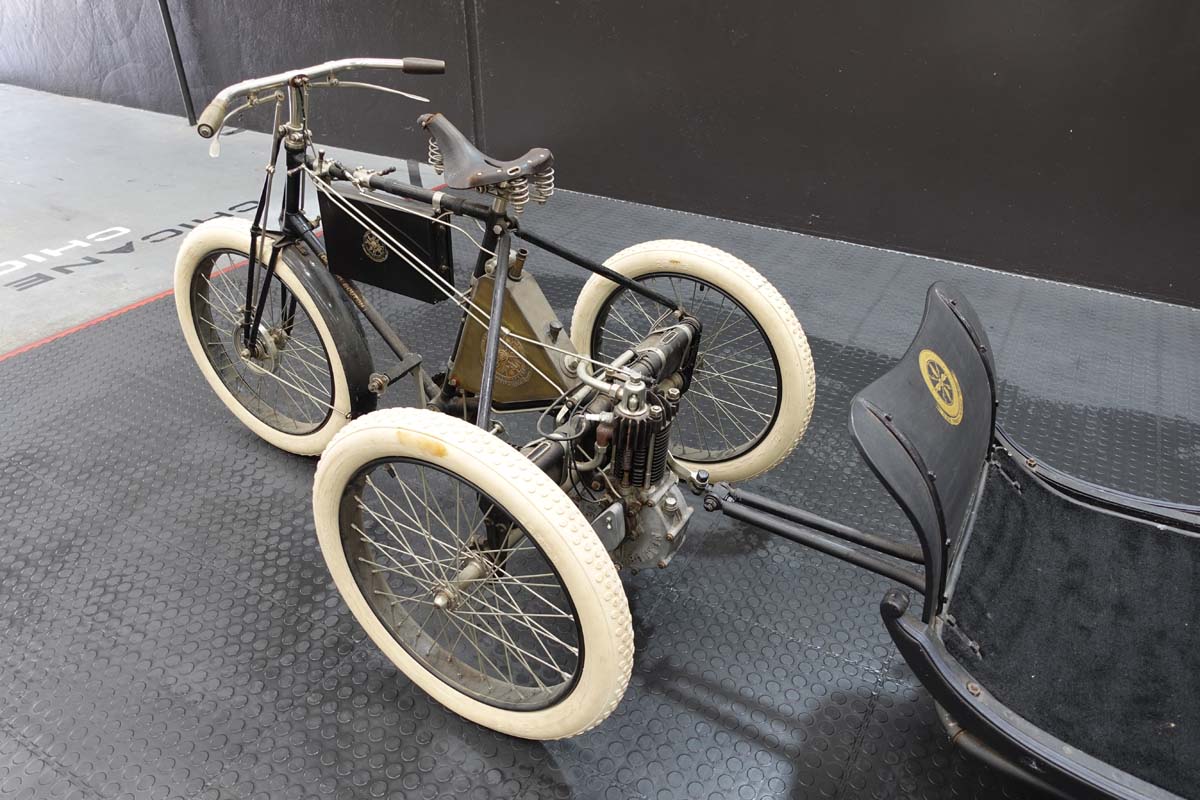
A single-cylinder engine was standard for the De Dion-Bouton tricycle throughout its production. Increasing the bore and other changes improved power from an initial 0.5hp to 1.75hp by the time this 1898 model was released.
In this form, the De Dion-Bouton tricycle remained mostly unchanged for over a year. A 2.25hp (1.67kW) engine arrived in mid-1899, when De Dion-Bouton’s first petrol-engined ‘voiturette’ four-wheel car made its debut. This saw interest in the tricycle fade, with the final examples built in 1902, although the engine would remain in production until 1909.
From 1895 to 1902, De Dion-Bouton tricycle production is estimated to have reached 15,000 units, with a further 50,000 engines supplied separately to other manufacturers for a range of applications.
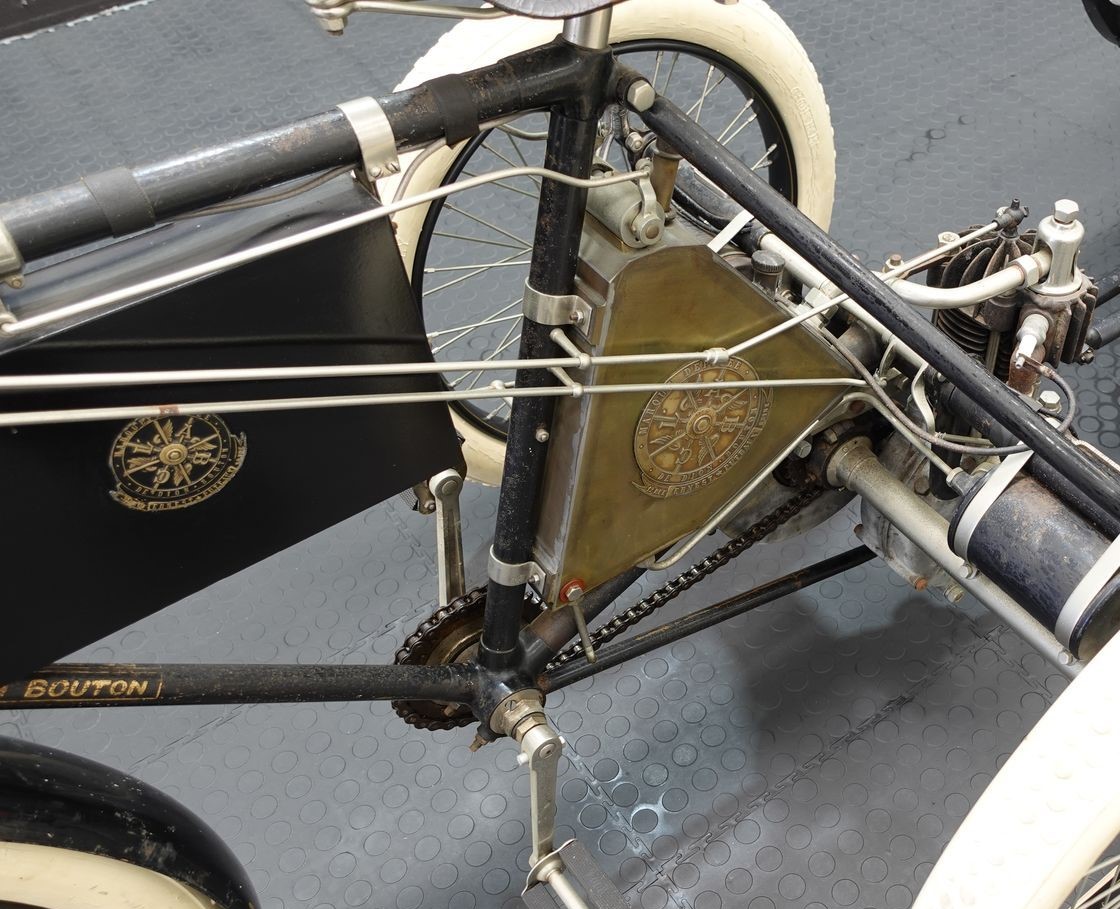
Square box slung under the crossbar holds dry cell batteries for the spark plug. Triangular box behind the seat is the surface carburettor.
Long-Term Ownership
The 1898 De-Dion Bouton tricycle featured here was recently sold by Melbourne-based boutique auction house, Chicance Auctions. Purchased new by Dr. Arthur Syme in 1899, it had remained with the same family until this auction.
Arthur Syme was a son of David Syme, the influential publisher of The Age newspaper in Melbourne. Launched under different ownership in 1854, The Age was purchased by David’s elder brother, Ebenezer Syme in 1856. David, who had newspaper experience in his native Scotland, joined his brother at The Age and would grow its circulation and influence in the following decades. Mirroring the history of this De Dion-Bouton, The Age would be owned by the Syme family for more than a century.
Dual levers on the frame crossbar control fuel delivery. Third lever at the front adjusts the timing.
Of David Syme’s five sons, three entered the newspaper business, but Arthur Syme turned to medicine instead. After studying in Melbourne and Edinburgh, Arthur established a practice in Lilydale in 1895. The De Dion-Bouton would be ridden for his rounds, with the two-seat trailer seen in some of the included images used to ferry patients to and from the practice. Known as a ‘remorque’ (‘trailer’ in English), its resemblance to a trotting sulky has led to that name being applied.
Dual levers on the frame crossbar control fuel delivery. Third lever at the front adjusts the timing.
Used, Preserved, Restored, Displayed
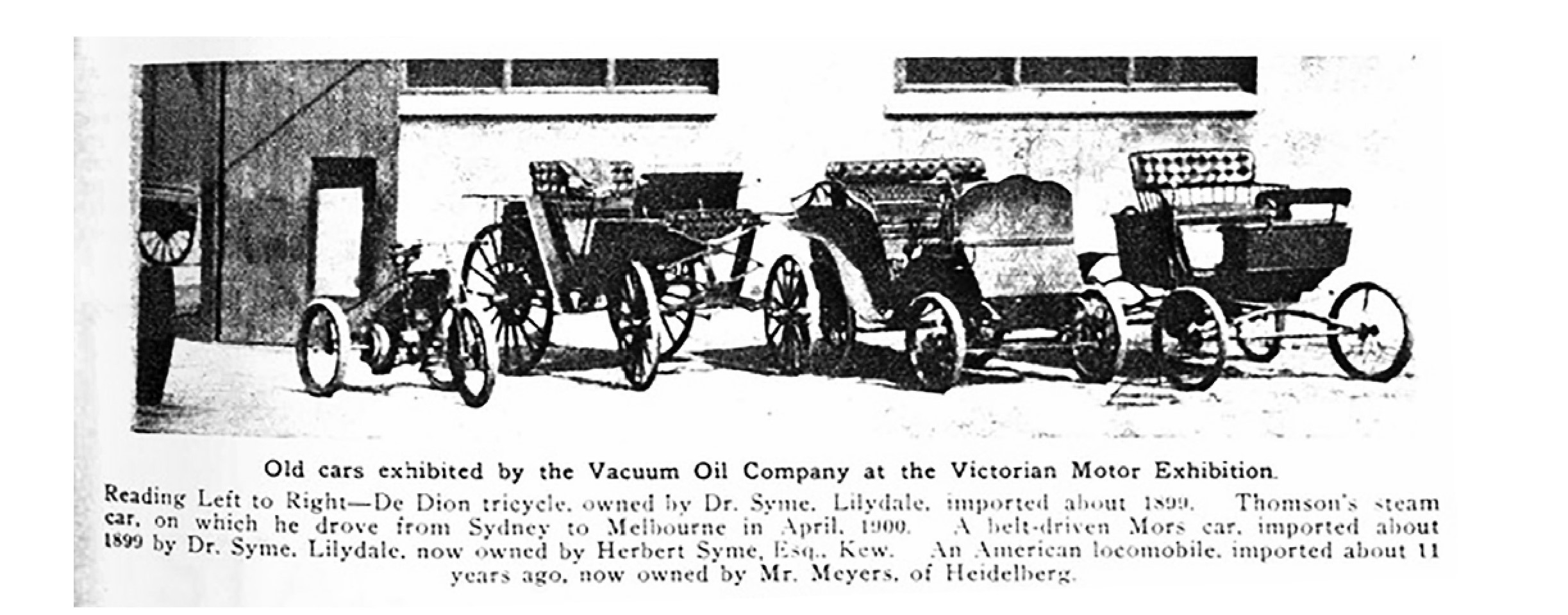
It’s unclear how long Arthur Syme used this De Dion tricycle, but rapid development in the automotive industry meant it was already considered an historical relic when it was presented at the ‘Victorian Motor Exhibition’ in 1912, alongside other early vehicles that included the locally-built Thomson Steam Car from 1898.
Two-passenger sulky was an accessory available for these tricycles when new. Another accessory changed the front end to two wheels with a single passenger seat mounted ahead of the rider, creating what's known as a 'forecar'.
Subsequent generations of the Syme (later Dennis) family kept the De Dion-Bouton in operational condition, with J.T.S. Dennis riding it in some of the first Veteran Car Club of Australia (VCCA) events.
In 1997, the De Dion was restored by Jack Hawke, a veteran vehicle enthusiast and former Ford engineer. Upon completion of the restoration, this De Dion-Bouton was displayed in numerous venues, including the Ford Discovery Centre in Geelong, but remained in the possession of the Syme/Dennis family.
In 1912, Arthur Syme’s De Dion-Bouton was presented alongside other “historic” vehicles at a Victorian automobile exhibition that was a forerunner to the Melbourne Motor Show.
To Auction
Ahead of its listing in Chicane’s December showroom auction, Michael Edwards, a marque expert and the author of several books on De Dion-Bouton, authenticated this vehicle. The VCCA’s Graeme Jarrett added that, of the five examples of a De Dion-Bouton tricycle thought to be in Australia, this is the only one that’s been here from new.
An impressive hammer price of $75,500 (excl. buyer’s premium) for this rare, 127-year-old vehicle was within estimate and exceeded the prices achieved by some very desirable cars in this auction.